Philadelphia Airport Terminals
All the information featured on this page was compiled and written by David Enrich, a renowned expert in aviation and airport guides, since 1999.
Philadelphia International Airport (PHL) is the largest airport in Pennsylvania and one of the busiest hubs on the East Coast of the United States. The airport serves as a major hub for American Airlines and handles tens of millions of passengers every year, connecting Philadelphia with destinations across North America, Europe, the Caribbean and the Middle East.
PHL currently features seven passenger terminals: A-West, A-East, B, C, D, E and F. All terminals are interconnected airside after security, allowing passengers to move between most gates without leaving the secure area. The airport combines modern international facilities with older historic sections that have been renovated over time.
PHL can involve long walking distances between terminals, especially between Terminal F and the international gates in Terminal A-West.
Airport History & Origins
Philadelphia Airport began operations in the 1940s and gradually expanded into one of the most important airports in the northeastern United States. During the 1970s and 1980s, major terminal expansions transformed the airport into a significant domestic and international hub.
The airport’s most important modern development came with the construction of Terminal A-West, designed to handle long-haul international flights with larger aircraft and upgraded customs facilities. Today, PHL combines historical airport infrastructure with modernized passenger facilities, lounges, shopping areas and international services.
Terminal A-West was specifically designed to accommodate widebody aircraft operating long-haul international routes.
Terminal Map
Below you can find a map of Philadelphia International Airport terminals and gate areas.
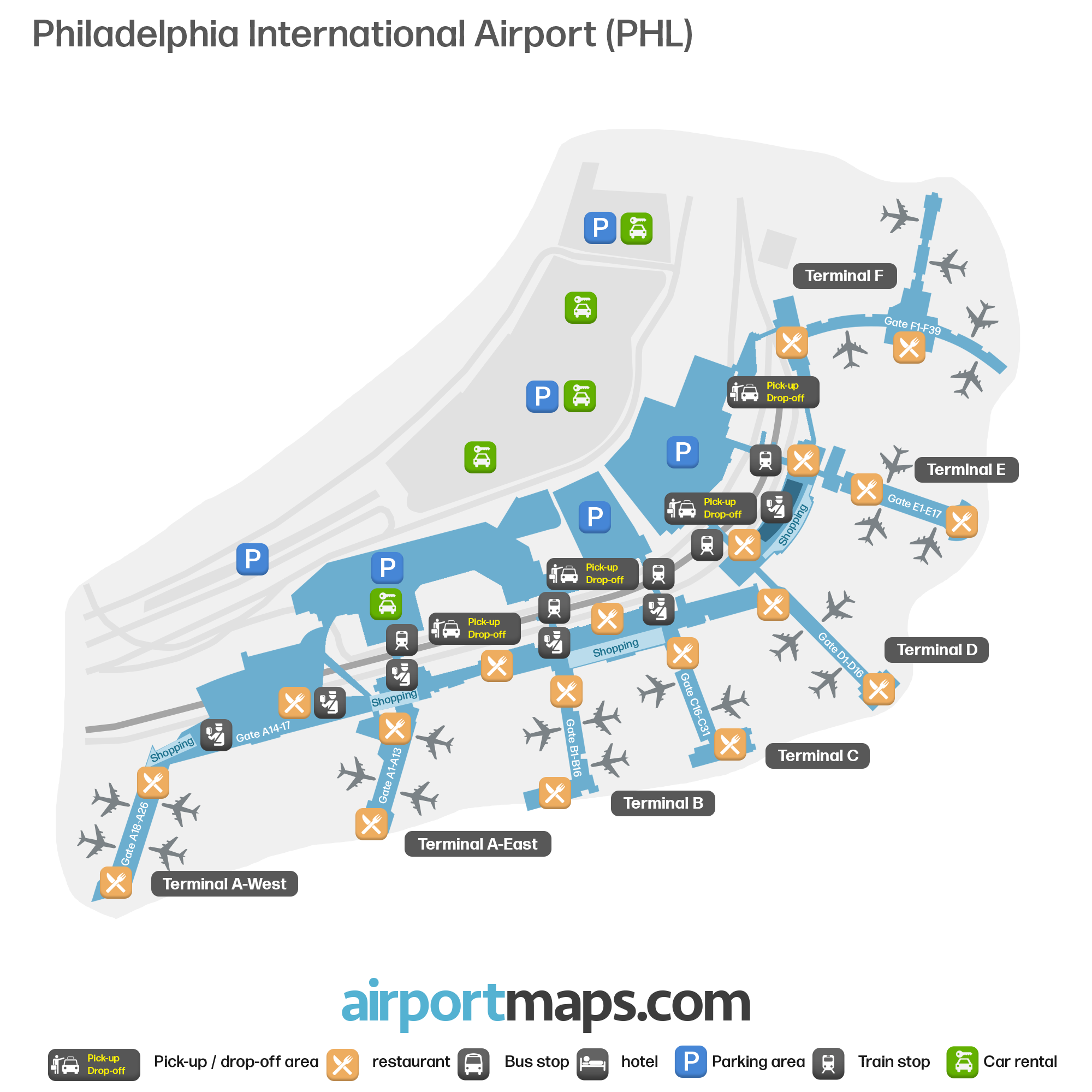
PHL Terminal Overview
Terminal A-West & A-East
Terminal A is the airport’s primary international area and one of the newest sections of PHL. A-West handles most intercontinental flights and features large waiting areas, premium lounges, modern customs facilities and extensive dining options.
- International departures and arrivals
- Widebody aircraft operations
- Premium lounges and business facilities
- Duty Free shopping available
- Large passport control facilities
A-East mainly handles domestic and some international flights operated by American Airlines and partner carriers.
Passengers arriving on international flights should allow additional time for immigration and customs processing.
Terminals B & C
Terminals B and C are heavily used by American Airlines domestic operations. These terminals handle many business routes and East Coast connections.
- Large number of daily departures
- Business-focused routes
- Good shopping and dining options
- Direct walking connection between terminals
- Frequent departures throughout the day
Terminals D & E
Terminals D and E serve a mix of domestic airlines including low-cost carriers and regional operators. These terminals are popular among leisure travelers and domestic passengers.
- Budget airline operations
- Large food court area
- Family-friendly waiting zones
- Modern seating areas with charging stations
- Good connections to security checkpoints
Terminal F
Terminal F handles regional and commuter flights, primarily operated by American Eagle. The terminal is smaller and generally easier to navigate than the rest of the airport.
- Regional jet operations
- Shorter walking distances
- Fast boarding process
- Ideal for domestic connections
Terminal F is connected to the rest of the airport through shuttle and walking corridors, but transfer times can still be longer than expected.
Popular Routes from Philadelphia Airport
Security & Baggage Control
Security wait times at PHL vary significantly depending on terminal, airline and departure time. Morning departures are usually the busiest period.
- TSA PreCheck available
- Multiple security checkpoints
- Additional screening during peak hours
- International flights require passport checks
Passengers flying internationally should arrive at least 3 hours before departure during busy travel periods.
Typical Airport Process Times
Airport Facilities
Free Wi-Fi
Unlimited Wi-Fi is available throughout all terminals and gate areas.
ATMs & Banking
ATMs and currency exchange facilities are located across the airport.
Charging Stations
Charging points are available near most boarding gates.
Dining & Shopping
Large selection of restaurants, bars, cafés and retail stores.
Families & Reduced Mobility Assistance
Philadelphia Airport provides services for families traveling with children and passengers requiring accessibility assistance.
- Accessible elevators and restrooms
- Wheelchair assistance available
- Family restrooms
- Baby-changing facilities
- Accessible shuttle transport
- Dedicated assistance desks
Lost & Found
Passengers who lose personal belongings at PHL should contact the airport’s Lost & Found office or their airline depending on where the item was lost.
- Lost property office available
- Airline baggage desks in arrivals
- TSA lost property services available
- Online claim systems for some airlines
Check-in & Boarding Information
Check-in counters are located directly inside each terminal depending on airline and destination. Most airlines also provide self-service kiosks and online check-in options.
- Online check-in highly recommended
- Bag drop counters available
- Gate changes possible during busy periods
- Boarding usually begins 30-50 minutes before departure
Always monitor departure screens regularly, as gate assignments at PHL can occasionally change with short notice.
Terminal Insider Tips
- Allow additional walking time between terminals.
- Terminal A-West offers the best international facilities.
- Morning departures are usually the busiest time at PHL.
- TSA PreCheck can save considerable time during peak periods.
- Food and shopping options improve significantly after security.
- International arrivals can experience long immigration queues.
- Terminal F is smaller but farther from the main international areas.